











































Welcome To SAS Points — Your One-Stop IT Solutions Provider

In today’s fast-moving digital world, network performance plays a critical role in business success. Modern companies depend heavily on stable wireless connectivity for communication, cloud applications, video conferencing, smart office technologies, security systems, and remote collaboration. As the number of connected devices continues growing, businesses require more powerful and intelligent wireless solutions capable of handling heavy traffic while maintaining speed, security, and reliability.
Traditional wireless routers are no longer sufficient for enterprise environments where hundreds of employees and devices rely on seamless internet access every day. This is where advanced enterprise access points become essential. Enterprise-grade access points are specifically designed to provide broader wireless coverage, faster speeds, higher device capacity, centralized management, and advanced security features that support modern business operations.
Whether you are managing a corporate office, hotel, educational campus, hospital, retail chain, or industrial environment, investing in high-performance wireless infrastructure can significantly improve productivity and user experiences. Modern access points now include advanced technologies such as Wi-Fi 6, Wi-Fi 6E, AI-powered optimization, cloud management, mesh networking, and integrated cybersecurity systems.
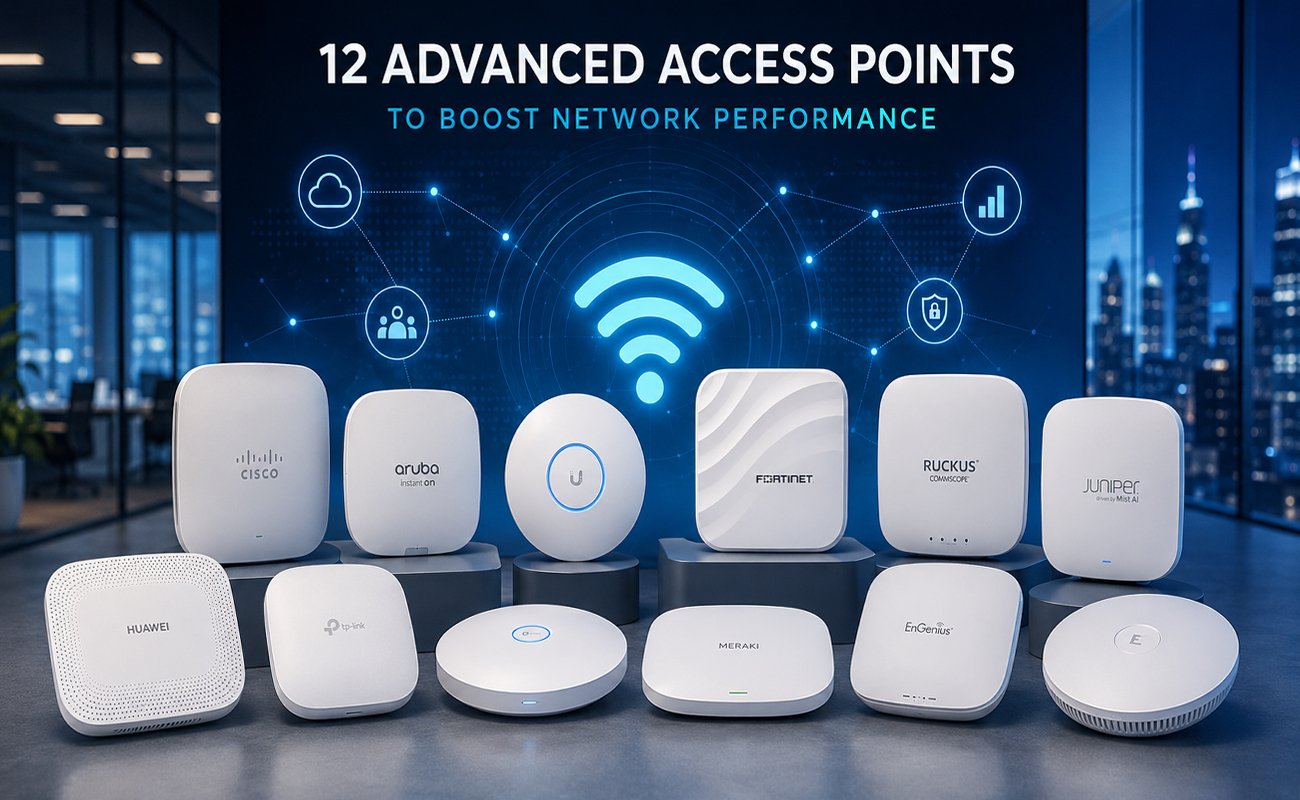
In this comprehensive guide, we explore 12 advanced access points that can dramatically improve wireless performance and help organizations build reliable, future-ready networks.
Before exploring the top access points available today, it is important to understand why enterprises are upgrading their wireless infrastructure.
Modern workplaces contain laptops, smartphones, IP phones, IoT devices, printers, security cameras, tablets, and smart office systems. A single office may support hundreds or even thousands of simultaneous wireless connections.
Businesses now rely heavily on cloud platforms such as Microsoft 365, Google Workspace, Zoom, and cloud storage systems. These services require stable, high-speed internet connectivity.
Employees frequently work remotely or move between office locations, requiring seamless wireless access without interruptions.
Wireless networks are increasingly targeted by cyber threats. Advanced access points provide stronger encryption, network segmentation, and threat detection.
Video streaming, virtualization, large file transfers, and real-time collaboration require high-performance wireless networking solutions.
When selecting enterprise access points, businesses should evaluate several important features.
These technologies provide faster speeds, lower latency, and improved performance in high-density environments.
Cloud-managed platforms simplify monitoring, updates, and troubleshooting.
Enterprise APs should include WPA3 encryption, user authentication, VLAN support, and intrusion prevention.
The infrastructure should support future growth without requiring complete replacement.
Access points must support large numbers of connected users simultaneously.
Users should move between access points without losing connectivity.
Cisco remains one of the most trusted networking brands for mission-critical enterprise deployments.
Aruba solutions are known for combining strong performance with simplified network management.
UniFi remains highly popular among growing businesses and managed service providers.
Fortinet APs are excellent for businesses prioritizing both performance and security.
Ruckus access points are widely recognized for excellent wireless coverage and signal quality.
It provides excellent performance while remaining easy to manage for businesses with limited IT resources.
Juniper Mist simplifies network management using artificial intelligence.
Meraki simplifies enterprise networking through an intuitive cloud platform.
Organizations upgrading to advanced enterprise APs gain multiple long-term advantages.
Modern APs support higher throughput for demanding applications.
Employees and customers benefit from stable and responsive connectivity.
Advanced encryption and network protection reduce cybersecurity risks.
Enterprise-grade equipment offers higher reliability and redundancy.
Modern APs support future expansion and emerging technologies.
Wireless networking continues evolving rapidly.
Businesses are beginning to adopt Wi-Fi 7 for even faster speeds and lower latency.
Artificial intelligence will automate network optimization and troubleshooting.
More connected devices will increase demand for reliable wireless infrastructure.
Cloud-based networking platforms will continue growing in popularity.
Zero-trust architectures and advanced threat detection will become standard features.
Enterprise wireless networking has become a critical foundation for modern business operations. Organizations now depend on stable, high-speed, and secure Wi-Fi connectivity to support employees, customers, cloud services, and smart technologies.
The 12 advanced access points highlighted in this guide represent some of the best enterprise wireless solutions available today. Each offers unique strengths, including high-performance connectivity, advanced security, centralized management, scalability, and intelligent optimization.
Whether your organization requires powerful enterprise-grade infrastructure, simplified cloud management, AI-driven optimization, or advanced cybersecurity integration, these access points provide reliable solutions for modern networking demands.
Investing in advanced wireless infrastructure not only improves network performance but also supports long-term business growth, productivity, and digital transformation initiatives.
No account yet?
Create an AccountContact us