










































Firewalls play a critical role in protecting business networks from unauthorized access, suspicious traffic, and cyber threats. However, not all firewalls provide the same level of inspection or security.
A Stateful Firewall vs Next-Generation Firewall comparison is especially important for businesses deciding whether traditional connection-based protection is enough or whether they need deeper application and threat visibility.
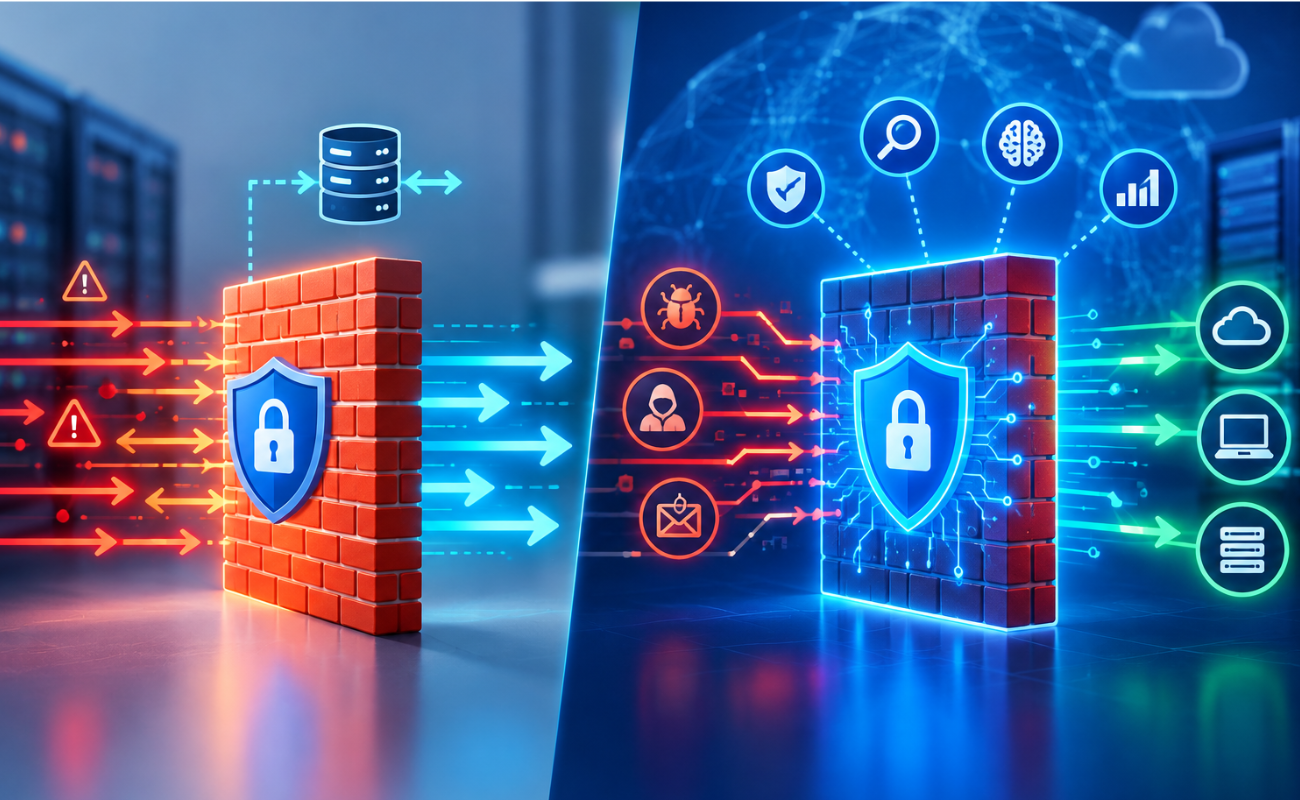
A stateful firewall tracks active connections and makes filtering decisions based on connection state, IP addresses, ports, and protocols. A Next-Generation Firewall (NGFW) builds on these capabilities by adding features such as application awareness, integrated intrusion prevention, user identity awareness, advanced threat detection, and deeper traffic inspection.
In this guide, we compare 8 major differences between stateful firewalls and next-generation firewalls.
1. Traffic Inspection
The first major difference in a Stateful Firewall vs Next-Generation Firewall comparison is how each technology examines network traffic.
Stateful Firewall
A stateful firewall maintains a state table that tracks active connections. It can determine whether a packet belongs to an established and legitimate session based on information such as:
- Source IP address
- Destination IP address
- Source and destination ports
- Network protocol
- Connection state
This provides more context than basic stateless packet filtering.
Next-Generation Firewall
An NGFW retains stateful inspection but goes further by examining traffic at the application level. It can identify applications and apply policies based on what the traffic actually represents rather than relying only on ports and protocols.

Key difference: Stateful firewalls focus heavily on connection context, while NGFWs add application and threat context.
2. Application Awareness
Application awareness is one of the clearest differences between the two technologies.
Stateful Firewall
A traditional stateful firewall generally uses network information such as IP addresses, ports, and protocols to create security policies.
For example, an administrator could allow TCP traffic through a particular port without necessarily knowing which specific application is generating that traffic.
Next-Generation Firewall
An NGFW can identify applications and create policies around them. This allows administrators to control applications rather than relying exclusively on port-based rules.
For example, an organization could create policies for:
- Business applications
- File-sharing applications
- Social media applications
- Collaboration platforms
- Streaming services
- Remote-access applications
Key difference: NGFWs provide much greater application visibility and control.
3. Intrusion Prevention
Another important difference in a Stateful Firewall vs Next-Generation Firewall comparison is intrusion prevention.
Stateful Firewall
A stateful firewall can control connections and block traffic that violates configured rules. However, traditional stateful inspection alone is not designed to provide the same integrated intrusion prevention capabilities found in an NGFW.
Next-Generation Firewall
NGFW platforms commonly integrate Intrusion Prevention System (IPS) capabilities. This allows the firewall to inspect traffic for known attack patterns and network exploits and take action according to security policies.
Why It Matters
Businesses may need protection against more than unauthorized connections. Modern networks also face:
- Exploit attempts
- Malicious traffic
- Application-based attacks
- Suspicious network behavior
- Known attack signatures
Key difference: NGFWs combine firewall functions with additional threat-prevention capabilities.
4. User and Identity Awareness
Traditional firewall policies are often based on network attributes.
Stateful Firewall
Policies can commonly be created using:
- IP addresses
- Ports
- Protocols
- Network zones
- Connection state
The firewall may not know which individual employee is responsible for the traffic.
Next-Generation Firewall
An NGFW can integrate user or identity information into security policies, depending on the platform and configuration.
This means policies can potentially be based on:
User → Device → Application → Destination
rather than simply:
IP Address → Port → Protocol
Cisco identifies user and identity awareness as one of the capabilities that distinguishes NGFW technology from traditional stateful firewall functionality.
Key difference: NGFWs can provide more context when enforcing access policies.
5. Threat Detection and Malware Protection
Security threats are another major consideration.
Stateful Firewall
A stateful firewall primarily focuses on controlling network connections. It can block unauthorized traffic according to configured rules but does not inherently provide the broad advanced-threat inspection associated with NGFW platforms.
Next-Generation Firewall
Modern NGFW platforms can integrate additional security capabilities such as:
- Advanced malware protection
- Threat intelligence
- Intrusion prevention
- URL filtering
- Application control
- Deep packet inspection
The exact capabilities vary by vendor, model, software version, and licensing.

Key difference: An NGFW can combine traditional firewall filtering with multiple additional security controls.
6. Encrypted Traffic Inspection
Encrypted traffic creates an additional challenge for network security.
Stateful Firewall
A traditional stateful firewall can enforce network policies around encrypted connections, but it does not necessarily provide the same deep TLS/SSL inspection capabilities associated with modern NGFW platforms.
Next-Generation Firewall
Many NGFW platforms support TLS/SSL inspection, allowing organizations to decrypt and inspect eligible encrypted traffic according to their security policies before re-encrypting it.
Cisco lists TLS/SSL decryption among the capabilities organizations may look for in an NGFW.
Important Consideration
Decryption can introduce:
- Additional processing requirements
- Privacy considerations
- Certificate-management requirements
- Compliance considerations
- Potential performance impact
Therefore, businesses should evaluate how encrypted traffic inspection will be implemented before enabling it broadly.
Key difference: NGFW platforms can provide deeper visibility into encrypted traffic when the feature is supported and properly configured.
7. Management and Security Visibility
Visibility is important when administrators need to understand what is happening across the network.
Stateful Firewall
A stateful firewall can provide logs and connection information, helping administrators monitor permitted and blocked traffic.
However, the amount of application and user-level context depends on the specific platform.
Next-Generation Firewall
NGFW platforms are designed to provide broader visibility across:
- Applications
- Users
- Devices
- Threats
- Websites
- Network activity
- Security events
Cisco describes comprehensive network visibility and contextual awareness as important NGFW capabilities.
This can help security teams investigate suspicious activity and create more detailed policies.
Key difference: NGFWs generally provide richer security context and centralized visibility.
8. Performance, Cost, and Complexity
The final difference is not simply about security features. Businesses also need to consider performance, cost, and operational complexity.
Stateful Firewall
A stateful firewall can be suitable when an organization primarily needs:
- Connection tracking
- IP filtering
- Port filtering
- Protocol control
- Basic network segmentation
Its simpler feature set can make deployment and management more straightforward.
Next-Generation Firewall
An NGFW provides additional security capabilities, but these can require:
- More processing resources
- More configuration
- Additional security expertise
- Security subscriptions or licenses
- More detailed policy management
Some NGFW platforms are designed to consolidate multiple security functions, which can reduce the need for separate security appliances and management systems.
Key difference: NGFWs can provide broader security capabilities, but businesses need to account for the additional operational and licensing requirements.
Stateful Firewall vs Next-Generation Firewall: Comparison Table
| Feature | Stateful Firewall | Next-Generation Firewall |
|---|---|---|
| Connection Tracking | ✓ | ✓ |
| IP-Based Filtering | ✓ | ✓ |
| Port & Protocol Filtering | ✓ | ✓ |
| Application Awareness | Limited | ✓ |
| User Identity Awareness | Limited | ✓ |
| Integrated IPS | Not inherent | ✓ |
| Advanced Threat Detection | Limited | ✓ |
| Malware Protection | Usually additional | Available depending on platform |
| TLS/SSL Inspection | Limited/Platform-dependent | Commonly available |
| Threat Intelligence | Limited | Available |
| Security Visibility | Network-focused | Application, user, and threat-focused |
| Configuration Complexity | Generally lower | Generally higher |
| Licensing Requirements | Depends on platform | Often additional for advanced features |
Stateful Firewall vs Next-Generation Firewall: How They Work
Understanding how each firewall operates can make the difference easier to visualize.
Stateful Firewall
User/Device → Connection → Stateful Inspection → Allow or Block
The firewall checks whether traffic belongs to a legitimate connection and whether it complies with configured rules.
Next-Generation Firewall
User/Device → Connection → Application Identification → Content/Threat Inspection → Security Policy → Allow, Block, or Inspect
An NGFW adds multiple layers of context to the decision-making process.
When Is a Stateful Firewall Suitable?
A stateful firewall may be suitable when a business needs straightforward network traffic control without requiring extensive application-level security features.
Potential use cases include:
- Basic network segmentation
- Internal network protection
- Smaller network environments
- Controlled network segments
- Environments with separate security tools providing advanced inspection
The actual requirements depend on the organization’s network architecture and threat model.
When Should a Business Consider an NGFW?
An NGFW may be considered when an organization needs more detailed visibility and security controls.
It can be relevant for businesses that require:
- Application-level policies
- Integrated IPS
- Advanced threat protection
- User-based policies
- URL filtering
- Threat intelligence
- Encrypted traffic inspection
- Centralized security visibility
Cisco and Palo Alto Networks both describe application awareness, identity/context, and integrated security inspection as key characteristics of NGFW platforms.
Stateful Firewall vs Next-Generation Firewall for Different Businesses
| Business Environment | Relevant Considerations |
|---|---|
| Small Office | Network size, simplicity, cost |
| Growing Business | Scalability and application control |
| Enterprise | Advanced inspection and centralized visibility |
| Data Center | Throughput, segmentation, security controls |
| Branch Office | Centralized management and connectivity |
| E-commerce Business | Network security plus specialized web protection |
| Hybrid/Cloud Environment | Application visibility and distributed security |
A WAF may also be needed for organizations protecting public-facing web applications because a WAF specializes in HTTP/HTTPS application traffic, while an NGFW provides broader network protection.
Popular Firewall Brands
Businesses can find stateful and next-generation firewall capabilities across major enterprise security vendors, including:
The exact capabilities should always be checked against the specific model, operating system, software version, throughput specifications, and licensing package.
How to Choose Between a Stateful Firewall and NGFW
Before purchasing or upgrading firewall infrastructure, consider these questions:
1. What Does Your Network Need to Protect?
Identify servers, workstations, applications, cloud services, remote users, and critical network segments.
2. How Much Application Visibility Do You Need?
If controlling applications is important, an NGFW can provide more detailed application awareness.
3. Do You Need Integrated IPS?
If intrusion prevention is required, check whether it is included in the selected platform and licensing package.
4. How Much Traffic Does Your Network Handle?
Look beyond the advertised firewall throughput. Advanced features such as IPS and TLS inspection can affect real-world performance.
5. What Is Your Security Team Capable of Managing?
More advanced security platforms can require additional configuration and monitoring expertise.
6. What Is Your Long-Term Growth Plan?
Consider expected increases in:
- Users
- Bandwidth
- Applications
- Branches
- Cloud services
- Remote access
Common Mistakes When Choosing a Firewall
Choosing Only Based on Price
A lower purchase price does not necessarily mean the solution meets your performance and security requirements.
Ignoring Licensing
Some advanced features require additional subscriptions or licenses.
Comparing Only Maximum Throughput
Firewall throughput can change when security services such as IPS or TLS inspection are enabled.
Not Checking Application Requirements
Businesses should understand which applications need to be identified, controlled, or inspected.
Forgetting Future Growth
A firewall should have enough capacity and functionality to support the organization’s expected development.
Assuming Every NGFW Is Identical
NGFW capabilities differ between vendors and models. Always check the actual technical specifications.
10 FAQs About Stateful Firewall vs Next-Generation Firewall
1. What is a stateful firewall?
A stateful firewall tracks active network connections and uses connection state along with network information to determine whether traffic should be allowed or blocked.
2. What is a Next-Generation Firewall?
A Next-Generation Firewall combines traditional stateful firewall capabilities with additional functions such as application awareness, IPS, identity awareness, and advanced threat detection.
3. What is the main difference between a stateful firewall and an NGFW?
The main difference is the depth of inspection and available security context. A stateful firewall focuses on connection and network information, while an NGFW adds application, identity, and advanced threat-security capabilities.
4. Can an NGFW perform stateful inspection?
Yes. Stateful inspection is a fundamental capability of NGFW technology.
5. Does a stateful firewall provide application awareness?
Traditional stateful firewalls generally have limited application awareness compared with NGFW platforms.
6. Does an NGFW include IPS?
Many NGFW platforms include integrated IPS capabilities, although the exact implementation and licensing depend on the vendor and product.
7. Can NGFWs inspect encrypted traffic?
Many modern NGFWs support TLS/SSL inspection, but the feature may require specific configuration, processing capacity, and licensing.
8. Is an NGFW always necessary for a small business?
Not necessarily. The appropriate solution depends on the organization’s network architecture, security requirements, applications, traffic levels, and available IT resources.
9. Can a stateful firewall and NGFW be used together?
Yes. Different firewall and security technologies can be deployed together when the network architecture requires multiple security layers.
10. What should businesses check before buying an NGFW?
Businesses should evaluate throughput, security features, application control, IPS, TLS inspection, management, scalability, licensing, support, and compatibility with their existing infrastructure.
Conclusion
The Stateful Firewall vs Next-Generation Firewall comparison comes down primarily to the depth of inspection, visibility, and security capabilities required by the business.
A stateful firewall provides important connection-aware traffic control based on factors such as IP addresses, ports, protocols, and connection state. An NGFW builds on this foundation with capabilities such as application awareness, identity-based policies, integrated IPS, threat intelligence, and advanced inspection.
The right choice depends on the organization’s network architecture, applications, traffic volume, security requirements, budget, and future growth.
Shop now
Sold out

Sold out
Sold out

Sold out
Sold out
Sold out
Related posts
Stateful Firewall vs Next-Generation Firewall: 8 Major Differences

Firewalls play a critical role in protecting business networks from unauthorized access, suspicious traffic, and cyber threats. Ho...
7 Firewall NGFW Types Compared for Business Network Security
Choosing the right NGFW firewall is an important part of protecting business networks fro...
11 Server Features Every IT Manager Should Look For

11 Server Features Every IT Manager Should Look For
Choosing the right server is an important decision for any organization. Serv...
Best RAM Options for Performance Workstations
Best RAM Options for Performance Workstations
Modern performance workstations are built for demanding workloads such as 3D render...
Dual-WAN vs Single-WAN Routers: 6 Key Differences Compared

Modern businesses rely heavily on stable Internet connectivity for cloud applications, communication, online platforms, remote acc...
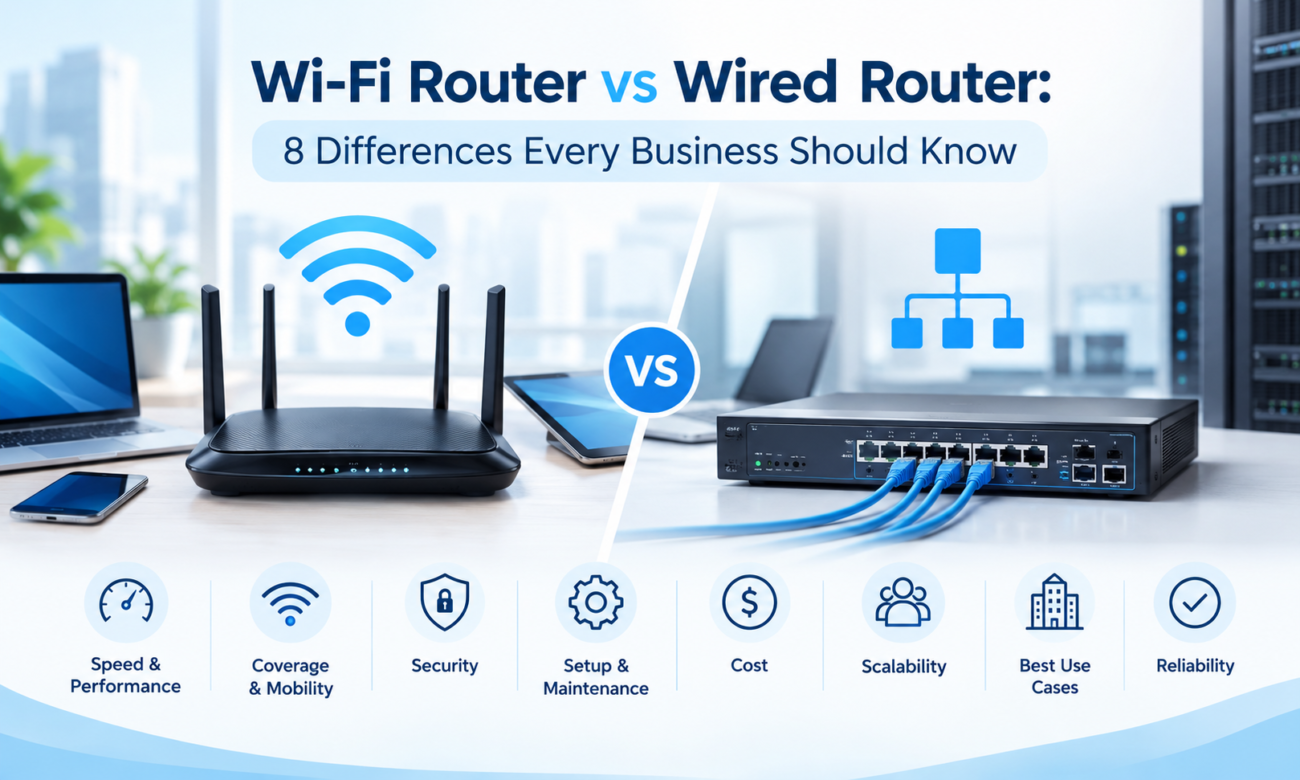
Wi-Fi Router vs Wired Router: 8 Differences Every Business Should Know
Choosing the right networking equipment is an important decision for any business. As organizations become increasingly dependent ...
Storage Buying Guide: 7 Things to Consider Before You Choose
Storage Buying Guide: 7 Things to Consider Before You Choose
Modern businesses generate and manage large amounts of data every da...
Business Router vs Home Router: 7 Key Differences Explained
Introduction
Choosing the right router can have a major impact on how efficiently a network performs. While home routers are desi...
What Is a Network Card and When to Upgrade It?
What Is a Network Card and When to Upgrade It?
In modern business networks, fast and reliable communication between computers, se...
How VLANs Work on Managed Switches: 7 Key Benefits for Business Networks
Introduction
As business networks continue to grow, connecting more devices to the same physical infrastructure can create signif...

How to Choose the Right Firewall for Your Business in 7 Steps
Introduction
Cybersecurity has become a major priority for businesses of every size. From small offices to large enterprises, org...
Hardware Firewall vs Cloud Firewall: 7 Key Differences for Businesses
Choosing the right firewall is an important decision for businesses that want to protect ...
