












































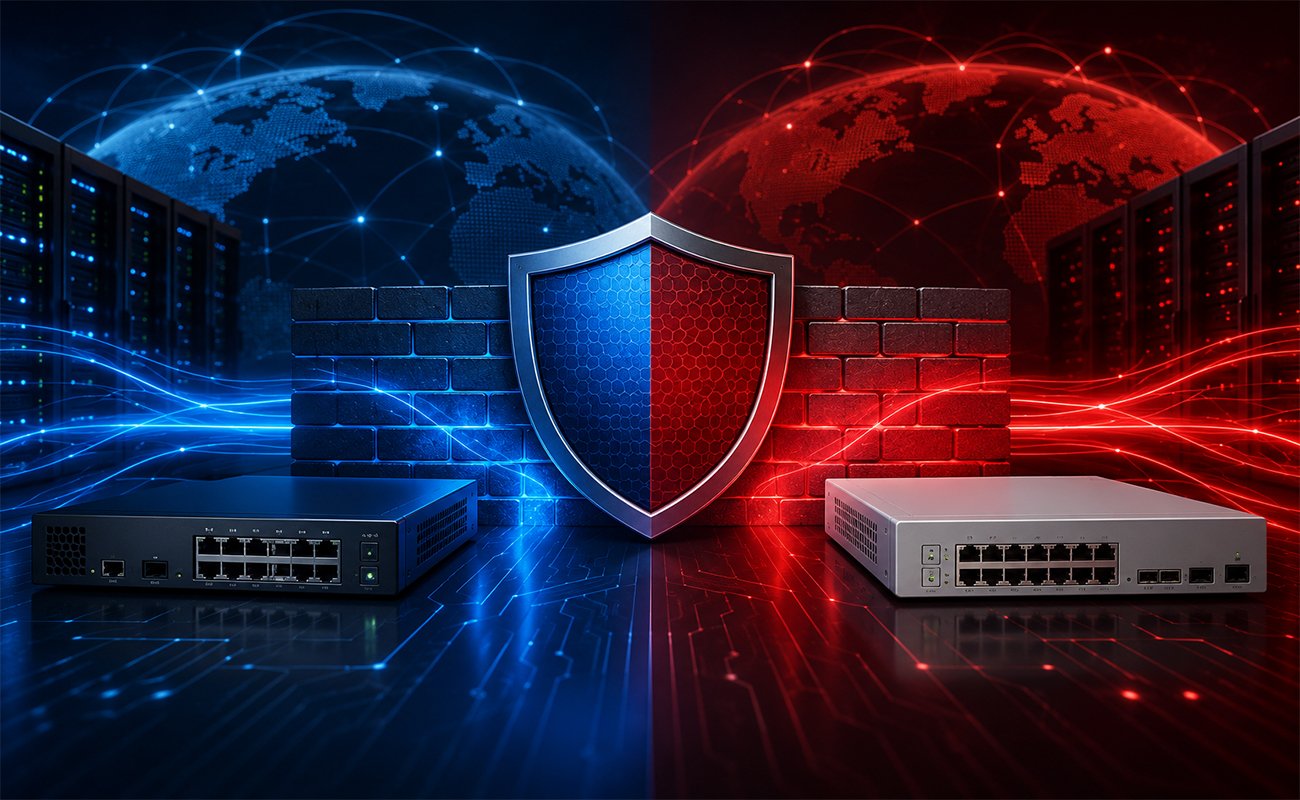
Choosing the right firewall is one of the most important cybersecurity decisions a business can make. As cyber threats continue to evolve, organizations need advanced security solutions that can protect sensitive data, prevent unauthorized access, and support business growth without compromising network performance.
Among the most recognized names in the firewall industry are Cisco and Fortinet. Both companies offer powerful security platforms designed to protect modern business networks, data centers, cloud environments, and remote workforces.
Cisco has built its reputation on enterprise networking and security innovation, while Fortinet is widely known for delivering high-performance cybersecurity solutions with strong security capabilities and competitive pricing.
While both vendors provide next-generation firewall (NGFW) solutions, they differ in areas such as performance, management, scalability, threat protection, and overall cost.
This guide examines nine important factors businesses should compare before deciding between Cisco and Fortinet firewalls.
1. Security Features


Security is the primary reason organizations invest in firewalls.
Cisco Firewall Strengths
- Advanced threat intelligence
- Integrated intrusion prevention
- Malware protection
- Secure access controls
- Deep network visibility
Fortinet Firewall Strengths
- AI-powered threat detection
- Advanced malware protection
- Web filtering
- Application control
- Real-time security analytics
Verdict
Both vendors provide excellent security capabilities, but Fortinet is often praised for offering a broader security feature set at competitive price points.
2. Performance and Throughput


Firewall performance directly impacts network speed and user experience.
Cisco
Cisco firewalls are known for stable enterprise performance and reliable operation in complex environments.
Fortinet
Fortinet has earned a strong reputation for high throughput performance due to its proprietary security processors.
Verdict
For organizations prioritizing maximum performance and throughput, Fortinet often has an advantage.
3. Ease of Management


Efficient management helps IT teams reduce operational complexity.
Cisco
- Powerful management tools
- Extensive customization
- Detailed policy controls
Fortinet
- User-friendly interface
- Simplified deployment
- Centralized management capabilities
Verdict
Fortinet is generally considered easier for smaller IT teams to manage.
4. Scalability


Growing organizations need security solutions that can scale with business requirements.
Cisco
Cisco excels in large enterprise environments with extensive networking ecosystems.
Fortinet
Fortinet offers flexible solutions suitable for small businesses, mid-sized organizations, and large enterprises.
Verdict
Both are highly scalable, but Cisco often appeals to very large enterprises with complex infrastructures.
5. Integration with Existing Infrastructure


Integration can significantly impact deployment efficiency.
Cisco
Cisco integrates exceptionally well with:
- Cisco switches
- Cisco routers
- Cisco wireless solutions
- Cisco security platforms
Fortinet
Fortinet integrates effectively with:
- FortiSwitch
- FortiAP
- FortiAnalyzer
- Third-party environments
Verdict
Organizations heavily invested in Cisco networking equipment may benefit from Cisco’s ecosystem advantages.
6. Threat Intelligence and Detection


Modern cyber threats require advanced detection capabilities.
Cisco
Uses global threat intelligence and advanced analytics to identify risks.
Fortinet
Leverages FortiGuard Labs to provide real-time threat intelligence updates.
Verdict
Both vendors offer strong threat intelligence services capable of protecting against emerging threats.
7. VPN and Remote Access Capabilities


Remote work has increased the importance of secure access solutions.
Cisco
Known for highly reliable VPN services and enterprise remote access solutions.
Fortinet
Provides secure VPN capabilities with simplified deployment and management.
Verdict
Both vendors perform well, though Cisco is often preferred in large enterprise remote-access environments.
8. Total Cost of Ownership


Cost is a major consideration when evaluating firewall solutions.
Cisco
- Typically, higher initial investment
- Strong enterprise support
- Extensive feature ecosystem
Fortinet
- Competitive pricing
- Strong performance-to-cost ratio
- Lower entry costs for many deployments
Verdict
Fortinet is often viewed as the more cost-effective option.
9. Vendor Support and Reputation


Reliable vendor support can make a significant difference during deployment and troubleshooting.
Cisco
- Global reputation
- Extensive training resources
- Large partner ecosystem
Fortinet
- Strong support services
- Growing market presence
- Comprehensive certification programs
Verdict
Cisco has a longer enterprise history, while Fortinet continues to gain market share through innovation and customer satisfaction.
Comparison Summary

| Factor | Cisco | Fortinet |
|---|---|---|
| Security Features | Excellent | Excellent |
| Performance | Strong | Excellent |
| Ease of Management | Advanced | User-Friendly |
| Scalability | Excellent | Excellent |
| Infrastructure Integration | Excellent | Very Good |
| Threat Intelligence | Excellent | Excellent |
| VPN Support | Excellent | Excellent |
| Cost Efficiency | Moderate | Strong |
| Vendor Reputation | Excellent | Excellent |
Which Firewall Is Best for Your Business?


Choose Cisco If:
- Your organization already uses Cisco infrastructure.
- You operate a large enterprise network.
- Advanced customization is a priority.
- You require extensive enterprise support.
Choose Fortinet If:
- You want strong security at a competitive price.
- High performance is a top priority.
- You need easier management.
- You are looking for excellent value for money.
Conclusion
Both Cisco and Fortinet offer industry-leading firewall solutions capable of protecting modern business networks. Cisco excels in enterprise integration, large-scale deployments, and advanced customization, while Fortinet stands out for its performance, ease of management, and cost-effectiveness.
The best choice ultimately depends on your organization’s infrastructure, security requirements, budget, and long-term growth plans. By carefully evaluating these nine factors, businesses can select the firewall platform that best supports their cybersecurity strategy and operational goals.
Shop now
Sold out

Sold out
Sold out

Sold out
Sold out
Sold out
Related posts
10 Router Security Features That Help Protect Business Networks

Business networks are constantly exposed to security risks, from unauthorized access and malicious traffic to compromised devices ...

Stateful Firewall vs Next-Generation Firewall: 8 Major Differences

Firewalls play a critical role in protecting business networks from unauthorized access, suspicious traffic, and cyber threats. Ho...

7 Firewall NGFW Types Compared for Business Network Security
Choosing the right NGFW firewall is an important part of protecting business networks fro...

11 Server Features Every IT Manager Should Look For

11 Server Features Every IT Manager Should Look For
Choosing the right server is an important decision for any organization. Serv...
Best RAM Options for Performance Workstations
Best RAM Options for Performance Workstations
Modern performance workstations are built for demanding workloads such as 3D render...

Dual-WAN vs Single-WAN Routers: 6 Key Differences Compared
Modern businesses rely heavily on stable Internet connectivity for cloud applications, communication, online platforms, remote acc...
Wi-Fi Router vs Wired Router: 8 Differences Every Business Should Know
Choosing the right networking equipment is an important decision for any business. As organizations become increasingly dependent ...

Storage Buying Guide: 7 Things to Consider Before You Choose
Storage Buying Guide: 7 Things to Consider Before You Choose
Modern businesses generate and manage large amounts of data every da...
Business Router vs Home Router: 7 Key Differences Explained
Introduction
Choosing the right router can have a major impact on how efficiently a network performs. While home routers are desi...
What Is a Network Card and When to Upgrade It?
What Is a Network Card and When to Upgrade It?
In modern business networks, fast and reliable communication between computers, se...

How VLANs Work on Managed Switches: 7 Key Benefits for Business Networks
Introduction
As business networks continue to grow, connecting more devices to the same physical infrastructure can create signif...

How to Choose the Right Firewall for Your Business in 7 Steps
Introduction
Cybersecurity has become a major priority for businesses of every size. From small offices to large enterprises, org...
